
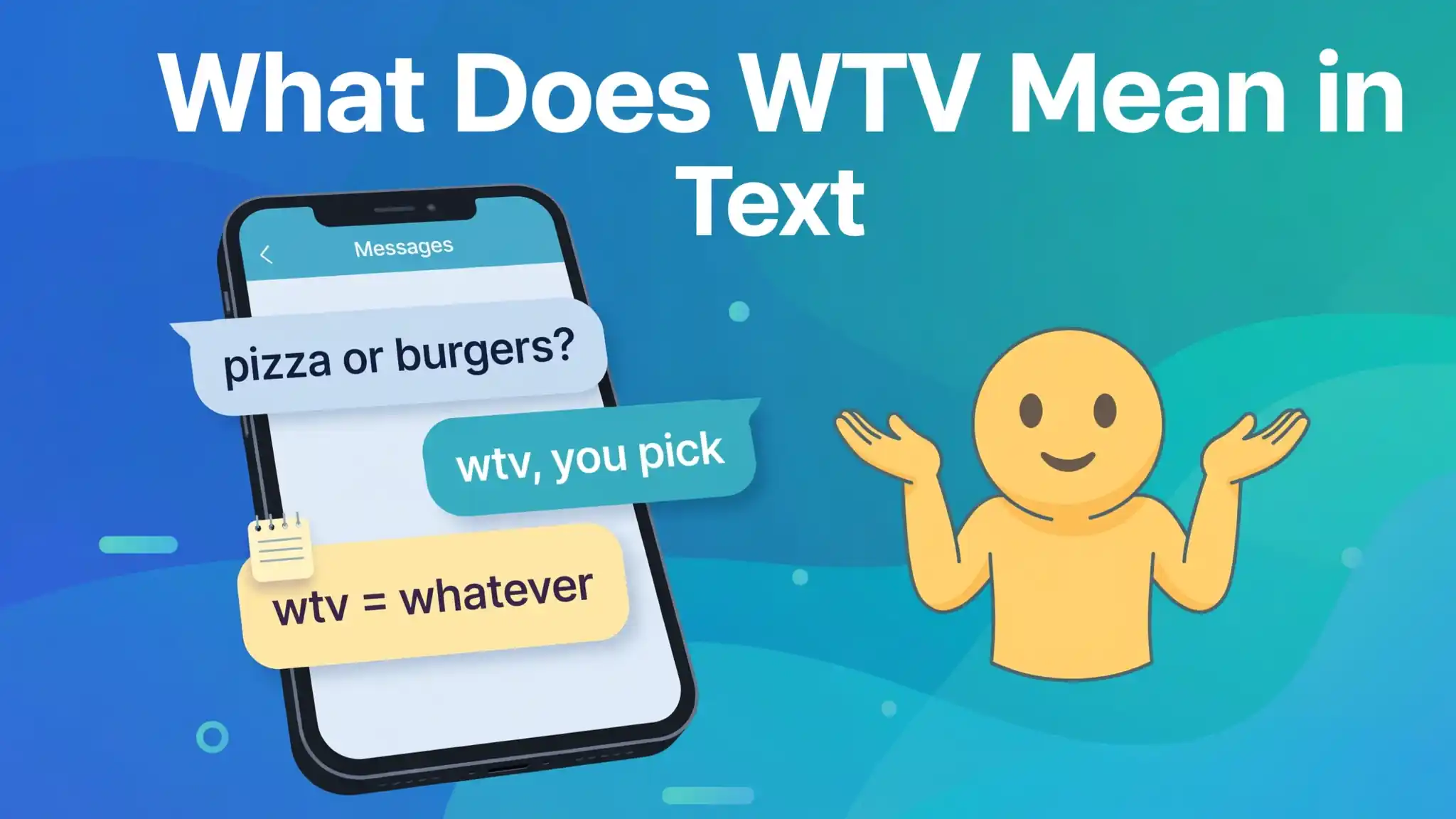
“wtv.” That is the whole reply. No explanation, no emoji — just three letters under the plan you just suggested. Anyone who has stared at that message has wondered what does wtv mean in text, and whether the sender is relaxed or quietly annoyed. The short answer is simple: WTV means “whatever.” It is the texting shrug — sometimes easygoing, sometimes dismissive — and the conversation around it tells you which one it is.
Tone is everything when you are working out what does wtv mean in text in a real chat. Sent to a friend who asked “pizza or burgers?”, WTV usually means “I am fine with either.” Sent after an argument, the same three letters can mean “I am done talking about this.” This guide breaks down both sides of WTV, with real examples, so you can read the tone correctly and reply the right way.
Quick Answer
WTV means “whatever” in texting and on social media.
It is a shortened way of writing “whatever,” used when someone has no strong preference, does not want to decide, or wants to end a topic. Depending on tone and context, WTV can sound:
- Easygoing: “Either option is fine with me.”
- Indifferent: “I do not really care.”
- Dismissive: “I am done with this conversation.”
You will see it most on Snapchat, Instagram, TikTok, Discord, and in everyday text messages between friends.
WTV Meaning at a Glance
| Form | Meaning | Typical Tone | Example |
|---|---|---|---|
| wtv | Whatever (no preference) | Easygoing | “wtv you want is fine” |
| wtv | Whatever (indifferent) | Neutral / flat | “wtv, you pick” |
| WTV | Whatever (dismissive) | Annoyed / rude | “WTV, I’m done” |
| whatevs | Whatever (playful) | Light, joking | “whatevs, let’s just go” |
| w/e | Whatever (older short form) | Casual | “w/e works for me” |
The letters never change. What changes is the mood behind them — and that mood comes from the conversation, the punctuation, and your relationship with the sender.
What Does WTV Mean in Text Messages?
When you are deciding what does wtv mean in text, start with what happened right before it. WTV is almost always a reaction. It answers a question, a suggestion, or a statement — and its meaning lives in that moment.
At its core, WTV does one of three jobs:
1. It hands the decision to you.
“Where should we eat?” — “wtv, you choose.” Here, the sender is not upset. They genuinely have no preference and are happy with whatever you pick.
2. It shrugs something off.
“You forgot your umbrella.” — “wtv, it’s not raining hard.” The sender is saying the issue is not a big deal to them.
3. It shuts a topic down.
“We need to talk about what happened.” — “wtv.” Here, WTV ends the discussion. It signals frustration, boredom, or a wish to avoid the subject.
Same word, three very different messages. That is why reading WTV well is less about the definition and more about the moment.
WTV as an Easygoing “Whatever”
This is the friendliest version. The sender trusts your choice and does not want to overthink a small decision.
Examples:
- “wtv time works for me, just lmk”
- “Movie or bowling? — wtv, both sound fun”
- “wtv you order, I’ll eat it”
Signs this is the easygoing version: the chat is relaxed, the topic is low-stakes (food, plans, times), and the sender keeps chatting normally afterward.
WTV as a Dismissive “Whatever”
This is the version people worry about — and often, they are right to. A dismissive WTV appears during tension and works like a verbal eye-roll.
Examples:
- “You never listen to me.” — “wtv”
- “Fine. wtv. do what you want”
- “WTV, I’m not arguing about this again”
Signs this is the dismissive version: the reply is very short, it follows a complaint or disagreement, it may come with a period (“wtv.”) that makes it feel final, and the sender often goes quiet afterward.
How to Tell Which WTV You Got
Use these four clues before you react:
1. The topic. Small decisions (food, plans, outfits) get the easygoing WTV. Feelings, apologies, and arguments get the dismissive one.
2. The length of the reply. “wtv, you pick the place” is relaxed and helpful. A bare “wtv” with nothing after it leans cold.
3. Punctuation and capitalization. “wtv!” or “wtv lol” softens it. “WTV.” in full caps with a period sharpens it. Punctuation is tone in texting.
4. What happens next. If the person keeps replying normally, it was a shrug. If they disappear for hours after “wtv,” the conversation probably hit a nerve.
WTV on Different Platforms
Snapchat: WTV is everywhere in quick replies, especially when friends are making plans in the moment. Short snaps get short answers, so “wtv u want” is normal, friendly shorthand there.
Instagram: In DMs and story replies, WTV works the same way — casual and fast. Under posts, it can read more dismissive, because public “whatever” replies often aim at the opinion in the post.
TikTok: Commenters use WTV to shrug off takes they do not agree with or do not care about: “wtv, the song is still good.” In TikTok comments, it usually leans indifferent-to-dismissive rather than friendly.
Texting and group chats: Among friends deciding plans, WTV is the group-chat shrug — “wtv, just tell me where.” In one-to-one chats with someone close, context carries even more weight, because a bare “wtv” from a partner or best friend rarely feels neutral.
Discord and gaming: Teammates use WTV when a strategy, map, or character choice does not matter to them: “wtv map, let’s just queue.” It is usually practical, not rude — unless it follows a lost team fight and an argument.
Is WTV Rude?
It can be — but it is not automatically rude.
WTV is rude when it dismisses a person, not just a decision: when someone shares a feeling, an apology, or something that matters to them, and the answer is a flat “wtv.” That tells them their message was not worth a real reply.
WTV is not rude when the stakes are small and the tone is warm. Friends trade “wtv” all day while making plans, and nobody takes offense, because everything else in the chat shows the mood is fine.
A simple test: replace WTV with the full word “whatever” and read the reply out loud. If it sounds like a shrug, it is fine. If it sounds like a door closing, it probably is.
14 Examples of WTV in Real Conversations
- “wtv you want for dinner is fine” — Easygoing. The sender hands you the choice, happily.
- “Wtv, I’m down for either” — No preference, but still enthusiastic. The follow-up sentence keeps it warm.
- “wtv time, just text me when” — Practical planning. WTV means the schedule is flexible.
- “eh, wtv, it happens” — Shrugging off a small problem, like a spilled drink or a missed bus.
- “wtv, do what you want” — Can go either way. After a calm planning chat, it is permission. After an argument, it is surrender with an edge.
- “WTV.” — One word, capital letters, a period. This is the dismissive version in its purest form.
- “wtv lol, that’s not even true” — Playful disagreement. The “lol” tells you the sender is joking, not shutting down.
- “You can wear wtv you want” — Reassurance about a choice, often about outfits or photos.
- “wtv he says, don’t trust it” — Here “wtv” starts a sentence meaning “whatever he says” — the long form hiding inside the short one.
- “Sorry I was late — wtv, you’re here now” — Forgiving. The sender waves the apology away kindly, the way a friend might add don’t worry to soften the moment.
- “wtv, I’m not doing this again” — A boundary, stated flatly. The sender is ending a repeated argument.
- “Ask him, ion care, wtv” — Slang stacked together: “I don’t care, whatever.” Indifference, doubled.
- “wtv works, see you at 7” — Plan confirmed. The shrug is only about the details, not the plan itself.
- “fine, wtv” — Resignation. Short, flat, and usually a sign the person needs space, not more messages.
Notice how often one extra word changes everything. “Wtv” alone is a wall; “wtv, you pick” is an open door.
Mini Conversations Using WTV
Conversation 1 — Making plans (easygoing)
A: “Beach day or movie day?”
B: “wtv, I’m good with both”
A: “Beach then.”
B: “For sure, I’ll bring snacks.”
B’s “wtv” is pure flexibility, and the for sure energy from A keeps the plan moving.
Conversation 2 — After a disagreement (dismissive)
A: “You could’ve just told me earlier.”
B: “wtv.”
A: “Okay… talk later then.”
B’s one-word reply closes the topic. A reads it correctly and gives space instead of pushing.
Conversation 3 — The shrug that is actually fine
A: “My bad, I double-booked us.”
B: “wtv, we’ll go Sunday instead”
A: “You’re the best.”
Here WTV works like forgiveness. Paired with a my bad on one side and an easy fix on the other, nobody is upset at all.
How to Respond to WTV
Your reply should match the version of WTV you received.
If it was easygoing (plans and choices):
Just decide. “Okay, pizza it is” is the perfect answer to a planning shrug — the sender wanted you to choose.
If you cannot tell:
Ask one small question instead of guessing: “You good with that, or actually annoyed?” Naming it gently, or admitting I guess I am not sure how you mean that, clears the air faster than silent guessing.
If it was dismissive:
Do not chase. A calm “okay, we can talk later” respects the boundary and keeps your dignity. Sending ten more messages after a shutdown “wtv” almost never fixes the mood — and it may leave you shaking my head at your own phone an hour later.
If it hurt:
You can say so, briefly and without escalating: “That felt a bit cold, everything okay?” It gives the person a chance to clarify — sometimes they were just busy and typing fast.
How to Use WTV Without Sounding Rude
- Add a few words after it. “Wtv, you pick” sounds friendly. “Wtv” alone sounds like a shutdown.
- Use it for small decisions only. Food, times, places, outfits — safe. Feelings, apologies, serious news — never answer those with WTV.
- Soften it when you mean it kindly. An emoji, a “lol,” or a warm follow-up (“wtv works, can’t wait”) shows the shrug is relaxed.
- Skip the caps and the period. “WTV.” reads angry even when you are not. Lowercase, no period, feels ten times lighter.
- Do not use it at work or with teachers. In professional messages, write “I am happy with either option” instead. Short slang can read as careless there.
Variations and Related Forms
- wtv / WTV: The same word at different volumes. Lowercase is calmer; capitals feel louder and more annoyed.
- whatevs: A playful, slightly softer spin, common in joking conversations. It is hard to sound truly angry saying “whatevs.”
- w/e: An older texting abbreviation for “whatever.” You see it less in current chats, but it means exactly the same thing.
- whatever (written out): The full word carries the most tone. In an argument, a spelled-out “Whatever.” is usually the most dismissive version of all.
- wtvr: Occasionally used for “whatever” with an extra letter, mostly as a stylistic variant. Context rules still apply.
WTV vs. Related Slang
- WTV vs. IDC: IDC means “I don’t care.” It is stronger and colder than WTV in most chats. WTV can be friendly; IDC rarely is.
- WTV vs. IDK: IDK means “I don’t know.” It answers a knowledge question. WTV answers a preference question — different shrugs, different jobs.
- WTV vs. NVM: NVM means “never mind.” It cancels something the sender said. WTV reacts to something you said or suggested.
- WTV vs. DW: DW means “don’t worry.” It reassures the other person. WTV can accidentally do the opposite if the tone lands wrong, which is why the words after it matter.
- WTV vs. ION: ION is a casual way of writing “I don’t,” often in phrases like “ion care.” Combined as “ion care, wtv,” the message is indifference with the volume turned up.
FAQs About WTV in Texting
What does WTV mean on Snapchat?
On Snapchat, WTV means “whatever.” It usually appears in fast, casual replies about plans or choices, where it mostly means “I am fine with either.” After an argument, the same reply turns dismissive, just like in texting.
Is WTV rude in a text?
It depends on context. About small decisions between friends, WTV is casual and fine. As a reply to feelings, an apology, or serious effort from the other person, a bare “wtv” reads rude and dismissive.
What does WTV mean from a girl or a guy?
The meaning does not change: “whatever.” What matters is the moment it was sent. During relaxed planning it is easygoing; during tension it is a shutdown — whoever sent it.
What should I reply when someone sends “wtv”?
If it is about plans, simply choose: “Okay, let’s do Friday.” If it follows an argument, give space with a calm reply like “okay, talk later.” And if you genuinely cannot tell, ask one short clarifying question.
What does “wtv” with a period mean?
“Wtv.” with a period usually feels more final and annoyed than a bare “wtv,” because the period makes it read like a complete, closed statement. It is a small punctuation change with a big tone change.
Is WTV the same as IDC?
No. They overlap, but IDC (“I don’t care”) is stronger and more negative. WTV often just means “no preference.” If you want to sound relaxed rather than cold, WTV with a friendly follow-up is the safer choice.
Can WTV be used at work?
It is best avoided in professional messages. Even when you mean it kindly, “wtv” can read as careless or annoyed. Write the full sentence instead: “Either option works well for me.”
What does WTV mean in gaming?
In gaming and Discord chats, WTV usually answers a choice about a map, mode, or strategy and means “any is fine.” It only turns negative when it appears right after an argument or a frustrating loss.
How is WTV different from “whatevs”?
They mean the same thing, but “whatevs” is more playful and lighthearted. It is the version friends use when they are clearly joking, while “wtv” is shorter, flatter, and easier to misread.
Conclusion
Three letters, one shrug — and a tone that can swing from friendly to frosty in a single message. That is the whole story behind what does wtv mean in text: WTV stands for “whatever,” and whether it means “you choose, I am happy either way” or “I am done with this topic” depends on the moment, the punctuation, and what came before it. Read the context first, and when you use WTV yourself, give it a few friendly words to travel with — your meaning will land exactly the way you intended.
Key Takeaways
- WTV in texting means “whatever.”
- In planning chats, WTV usually means no preference — the sender is happy with your choice.
- After an argument, a short “wtv.” is dismissive and signals the sender wants the topic closed.
- Tone clues — topic, reply length, punctuation, and what happens next — tell you which WTV you received.
- Add words after WTV when you use it yourself, so a relaxed shrug does not read as rude.
- For feelings and serious topics, never reply with a bare “wtv” — give a real answer or ask for time to talk later.
[…] a chat. The same conversations often include a soft I guess (IG) when someone is unsure, a shrug of whatever (WTV) when they stop caring about a topic, a kind don’t worry (DW) when a friend tries to […]
[…] MK is one of several short replies that carry more tone than meaning. A dismissive cousin is whatever (WTV), an excited opposite is hell yes (HY), a disagreement may start with I don’t (ION, as […]
[…] chats, right next to phrases like I don’t (ION, as in “ion care anymore”), a flat whatever (WTV) when someone gives up on a topic, and not for sure (NFS) when a plan is still uncertain. When […]
[…] OFC is the opposite of unsure. And when someone answers a heartfelt question with OFC plus a flat whatever energy, that is the one combination that reads as genuinely annoyed — a rare, unmistakable […]
[…] other everyday confident yes. When someone does not want to choose at all, the answer is usually whatever (WTV) instead. When a promise needs extra weight, the answer gets upgraded to I swear to God […]
[…] sender wants company, not a commitment. It carries a soft whatever energy: no pressure, no fixed plan, just an open […]