
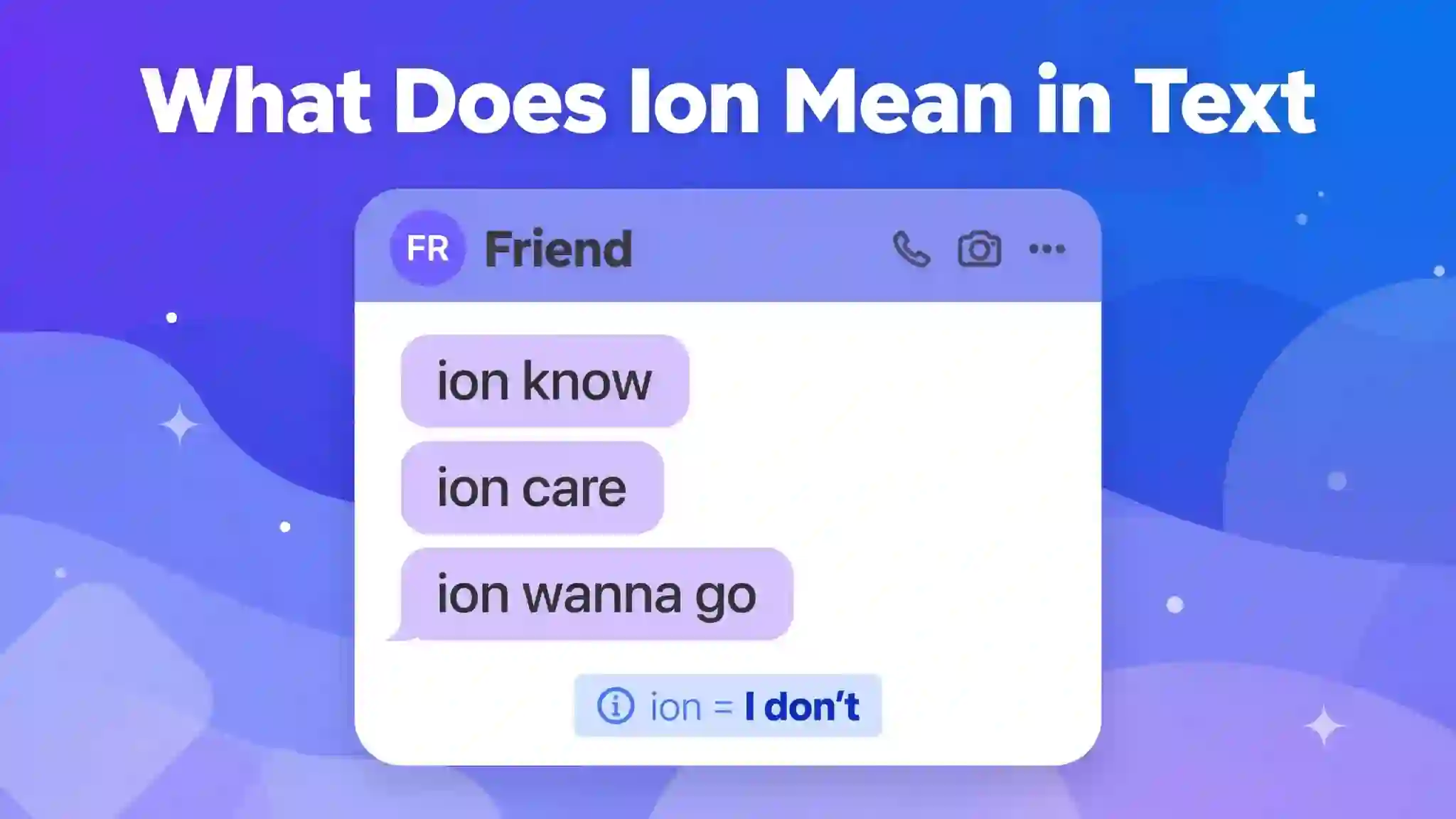
Receive a text saying “ion even know why you mad” or “ion wanna go anymore,” and suddenly, the message feels confusing. Ion is a popular texting slang for “I don’t,” so these phrases mean “I don’t even know why you’re mad” and “I don’t want to go anymore.” If you’re wondering what does ion mean in text, its meaning is usually simple, but the tone can change depending on the conversation. From Snapchat messages to TikTok comments, here’s how to understand and use it naturally.
Ion Meaning at a Glance
| Term | Meaning | Example |
| Ion | I don’t | “Ion think so.” |
| Ion know | I don’t know | “Ion know what happened.” |
| Ion care | I don’t care | “Ion care anymore.” |
| Ion wanna | I don’t want to | “Ion wanna leave.” |
| Ion even | I don’t even | “Ion even understand.” |
| ION (science) | An electrically charged atom or molecule | “Positive ions attract negative ions.” |
The first five examples show common informal texting usage. The scientific meaning is different and generally appears in educational, technical, or chemistry-related conversations.
What Does Ion Mean in Text Messages?
When you’re trying to understand what does ion mean in text, the most important clue is the sentence around it. In casual messages, ion usually replaces the spoken phrase “I don’t,” with the following words completing the thought.
People might write ion because it resembles how they pronounce the phrase in fast, casual speech. It also fits the informal writing style commonly seen in direct messages, comments, captions, and group chats.
Here are some common interpretations:
1. Ion Means “I Don’t”
This is the most common interpretation in everyday slang.
Examples:
- “Ion remember” means “I don’t remember.”
- “Ion have time” means “I don’t have time.”
- “Ion see it” means “I don’t see it.”
- “Ion believe you” means “I don’t believe you.”
Example conversation:
Alex: Are you coming to the party tonight?
Jordan: Ion know yet.
Meaning: Jordan doesn’t know yet whether they’ll attend.
2. Ion Can Sound Casual or Unbothered
Sometimes, ion makes a message sound relaxed, blunt, or unconcerned. However, the abbreviation itself doesn’t automatically mean someone is angry or being rude.
For example:
Person A: Why didn’t you reply to my message?
Person B: Ion feel like talking rn.
Here, “ion feel like talking rn” means “I don’t feel like talking right now.” Depending on the relationship and context, the response could sound honest, tired, dismissive, or slightly irritated.
The surrounding conversation matters more than the spelling alone.
3. Ion Can Express Frustration or Disbelief
People also use ion in emotional reactions.
Examples include:
- “Ion even know what to say.”
- “Ion got time for this.”
- “Ion understand why you did that.”
These messages can express confusion, frustration, disappointment, or disbelief. The emotion comes from the full sentence and situation, not necessarily from ion itself.
12 Realistic Examples of Ion in Texting
The following examples show how people may use ion in everyday digital conversations. Each includes the standard-English meaning so you can understand it quickly.
1. “Ion know lol.”
Meaning: I don’t know, laughing or keeping things casual.
2. “Ion care anymore.”
Meaning: I don’t care anymore. It may sound frustrated or detached.
3. “Ion wanna go out.”
Meaning: I don’t want to go out.
4. “Ion got your message.”
Meaning: I don’t have your message. Depending on context, the sender may be explaining why they haven’t seen it.
5. “Ion think that’s a good idea.”
Meaning: I don’t think that’s a good idea.
6. “Ion even remember saying that.”
Meaning: I don’t even remember saying that.
7. “Ion got no idea.”
Meaning: I don’t have any idea. The wording is informal and may vary by speaker.
8. “Ion feel like arguing.”
Meaning: I don’t feel like arguing.
9. “Ion see the problem.”
Meaning: I don’t see the problem.
10. “Ion wanna talk about it.”
Meaning: I don’t want to talk about it.
11. “Ion believe you did that 😭.”
Meaning: I can’t believe you did that. The emoji can suggest shock, amusement, or disbelief.
12. “Ion even know why I’m laughing.”
Meaning: I don’t even know why I’m laughing.
These examples illustrate informal usage, not a strict set of spelling or grammar rules. People may combine ion with other abbreviations, emojis, and casual expressions.
How to Understand Ion Based on Context
The easiest way to interpret ion is to read the entire sentence instead of treating the abbreviation as a standalone word.
Look at the words that follow it
The words after ion usually make the intended meaning clear.
- “Ion know” points to “I don’t know.”
- “Ion want that” points to “I don’t want that.”
- “Ion see why” points to “I don’t see why.”
- “Ion think so” points to “I don’t think so.”
Consider the conversation’s tone
The same expression can communicate different feelings.
For example, “Ion care” might mean someone genuinely doesn’t mind, or it might be a blunt way of expressing frustration. A previous disagreement, a playful exchange, or a serious discussion can change how the message comes across.
Check whether the conversation is about science
Not every use of ion is slang. In chemistry, an ion is an atom or molecule with an electrical charge because it has gained or lost electrons.
For example, “Sodium forms a positive ion” is a scientific statement, not a texting abbreviation.
If the conversation is about chemistry, physics, batteries, or electricity, the technical definition is probably the intended one.
Where Is Ion Commonly Used?
Ion appears in various forms of informal digital communication. Its use is particularly associated with casual speech patterns and online slang.
Text messages and group chats
Friends may use ion to type quickly or capture their everyday speaking style.
Example:
“ion know what we’re doing later 😭”
The sender means they don’t know what the group is doing later.
TikTok and Instagram
Ion can appear in captions, comments, memes, and direct messages.
Example:
“ion even know how this happened”
The phrase expresses confusion or surprise, depending on the post.
Snapchat and other messaging apps
In casual conversations, ion may be used when discussing plans, relationships, school, work, or everyday frustrations.
Example:
“ion think she coming”
This means “I don’t think she’s coming.”
The expression isn’t exclusive to any particular platform, and not everyone who uses these apps will recognize or use it.
Is Ion the Same as I Don’t?
They communicate essentially the same idea in many informal messages, but they aren’t identical in style.
| Feature | Ion | I don’t |
| Meaning in common slang usage | I don’t | I don’t |
| Style | Informal and conversational | Standard English |
| Best suited for | Casual chats and social posts | Casual or formal communication |
| Common in professional writing | Usually avoided | Appropriate |
| Potential for confusion | Higher | Lower |
For instance, “ion know what happened” is an informal version of “I don’t know what happened.”
Use ion when matching a casual texting style feels natural. Use “I don’t” in professional emails, school assignments, formal documents, and situations where clarity is important.
Ion vs. Other Similar Texting Slang
Several texting abbreviations communicate similar ideas or appear in the same kinds of messages. Knowing the differences helps you understand a wider range of conversations.
| Slang | Meaning | Example |
| Ion | I don’t | “Ion know.” |
| IDK | I don’t know | “IDK what happened.” |
| IDC | I don’t care | “IDC anymore.” |
| IMO | In my opinion | “IMO, it’s fine.” |
| NGL | Not gonna lie | “NGL, I’m tired.” |
| RN | Right now | “I’m busy rn.” |
| Ion wanna | I don’t want to | “Ion wanna leave.” |
Ion vs. IDK
Both can communicate uncertainty, but their wording differs.
- “Ion know” is a casual spelling of a spoken phrase.
- “IDK” is an initialism formed from the words “I don’t know.”
A person might write either expression in a casual conversation, depending on their preferred style.
Ion vs. IDC
These expressions aren’t interchangeable in every sentence.
- “Ion know” communicates uncertainty.
- “IDC” communicates a lack of concern or interest.
For example, if someone asks whether you’ll attend a concert, “ion know” means you’re unsure. “IDC” suggests you don’t particularly care.
Ion vs. ION in science
Capitalization and subject matter can help distinguish the meanings. In a chemistry lesson, ION may refer to an electrically charged particle. In a casual message, ion may represent “I don’t.”
Capitalization isn’t a perfect test because people often type slang in lowercase, but the surrounding words usually resolve the ambiguity.
How to Respond When Someone Says Ion
You don’t need a special response just because someone uses slang. Reply to the message’s meaning.
If they’re unsure:
Them: “Ion know if I’m going.”
You: “No worries, just let me know.”
If they don’t want to do something:
Them: “Ion wanna go out tonight.”
You: “That’s fine. We can stay in.”
If they’re expressing frustration:
Them: “Ion got time for this.”
You: “Sounds like you’re frustrated. Want to talk about it later?”
If you’re confused:
Them: “Ion even know.”
You: “Wait, you don’t know what happened?”
You can mirror their casual writing style if you’re comfortable with it, but you don’t have to use slang to fit in. Clear, natural replies work just as well.
Is Ion Rude or Disrespectful?
No, ion isn’t inherently rude. It’s an informal spelling, and its tone depends on the sentence and situation.
“Ion know lol” may sound relaxed, while “ion care what you think” may come across as dismissive. The second message can sound harsh because of its meaning, not simply because it uses ion.
If you’re unsure how a sender intended a message, consider your previous conversation, their usual texting habits, and whether they included cues such as emojis or playful wording. Avoid assuming that a short message is angry just because it uses slang.
Related slang worth knowing: Ion is rarely the only slang in a chat. The same conversations often include a soft I guess (IG) when someone is unsure, a shrug of whatever (WTV) when they stop caring about a topic, a kind don’t worry (DW) when a friend tries to calm things down, and a quick my bad (MB) when somebody admits a small mistake.
Frequently Asked Questions
1. What does ion mean in text from a girl?
When a girl texts ion, she usually means “I don’t,” just as other people do. For example, “ion know” means “I don’t know.” The expression doesn’t have a special meaning based on the sender’s gender.
2. What does ion mean in text from a guy?
A guy using ion is generally using the same slang meaning: “I don’t.” A message such as “ion wanna go” means “I don’t want to go.” The context helps reveal his tone and intention.
3. Does ion mean “I don’t know”?
Sometimes. The complete phrase “ion know” means “I don’t know,” but ion by itself generally represents “I don’t.” The word following it helps complete the meaning.
4. What does ion mean on Snapchat?
On Snapchat, ion usually means “I don’t” when it appears in informal messages. For example, “ion remember” means “I don’t remember.” The abbreviation isn’t exclusive to Snapchat.
5. What does ion mean on TikTok?
On TikTok, ion can appear in comments, captions, and videos as a casual way to write “I don’t.” A caption such as “ion even know” expresses uncertainty or confusion.
6. Is ion short for “I don’t”?
Yes. In common internet slang, ion is an informal, phonetic representation of “I don’t.” It isn’t a standard English contraction, and its spelling may confuse readers who aren’t familiar with the slang.
7. What is the difference between ion and IDK?
Ion usually represents “I don’t,” while IDK specifically means “I don’t know.” Therefore, “ion know” and “IDK” can express the same idea, even though they are written differently.
8. Can ion have a different meaning?
Yes. In chemistry, an ion is an electrically charged atom or molecule. In informal texting, it commonly represents “I don’t.” The topic and surrounding sentence determine which interpretation makes sense.
9. Should I use ion in formal messages?
It’s generally better to write “I don’t” in formal emails, workplace messages, academic writing, and other professional settings. Ion is best reserved for casual conversations where the recipient understands the slang.
Conclusion
The simplest way to understand what does ion mean in text is to remember that it usually stands for “I don’t.” You’ll often see it in expressions such as “ion know,” “ion care,” and “ion wanna,” particularly in casual messages and social media conversations.
Although the slang can sound relaxed, playful, frustrated, or dismissive depending on the situation, the spelling alone doesn’t determine the sender’s mood. Read the entire message, consider the conversation, and use the context to understand the intended meaning.
[…] slang worth knowing: ATP often shows up in frustrated, late-night chats, right next to phrases like I don’t (ION, as in “ion care anymore”), a flat whatever (WTV) when someone gives up on a […]
[…] slang worth knowing: IG lives in the same uncertain corner of texting as a few other short forms: I don’t (ION) for casual “I don’t know” replies, not for sure (NFS) when a plan is still […]
[…] slang worth knowing: Other short replies you will see in the same chats are I don’t for a casual brush-off, don’t worry when someone is reassuring you, and this shit in rougher, […]
[…] cousin is whatever (WTV), an excited opposite is hell yes (HY), a disagreement may start with I don’t (ION, as in “I don’t think you understood”), and a frustrated reaction is often […]
[…] someone is being completely serious, shaking my head (SMH) as the classic annoyed reaction, and I don’t (ION) in lines like “ion care anymore.” Its calmer summary phrase is at this point […]