
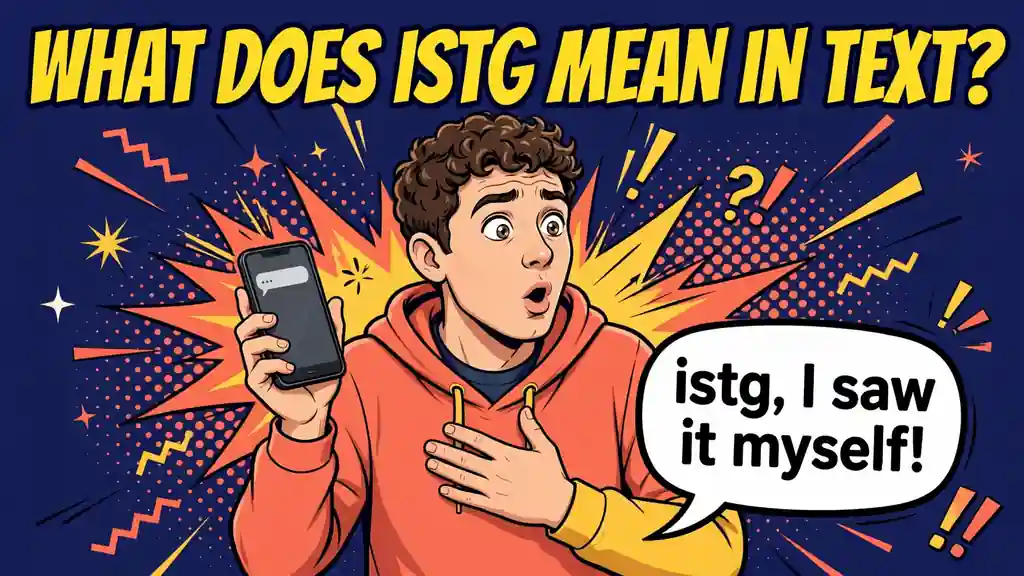
“ISTG if my wifi drops one more time, I’m throwing the router out the window.” Your friend is not making a religious vow — they are one dropped connection away from losing it. Four letters, three completely different moods, and if you have ever stared at a message wondering what does istg mean in text, you are not alone: it is one of the most-used reaction acronyms in modern chats.
Here it is: what does istg mean in text is, in full, “I swear to God” — used to promise something is true, to vent frustration, or to react in disbelief. It almost never has a religious meaning in chats; it is an intensity dial. Turn it up, and a plain statement becomes a promise, a complaint, or a gasp.
Quick Answer
ISTG means “I swear to God.” In texting it is used three ways: (1) to promise or stress that something is true (“ISTG, I studied all night”), (2) to vent frustration (“ISTG, if he shows up late again I’m leaving”), and (3) to react in shock or disbelief (“ISTG, did you see that?!”). It is spelled ISTG or istg — never iSTG.
ISTG at a Glance
| Detail | ISTG |
|---|---|
| Full form | “I swear to God” |
| Main uses | Promise/sincerity, frustration, disbelief |
| Tone | Intense, emphatic, dramatic — rarely literal |
| Where you will see it | Texting, Snapchat, TikTok, Instagram, Twitter/X, Discord |
| Origin | Early 2000s instant messaging shorthand |
| Related slang | OMG, FR (for real), ONG (on God), STG |
What Does ISTG Mean in Text?
ISTG is short for “I swear to God,” and it comes from the spoken phrase people have used for centuries to insist something is true — the courtroom-style oath, softened into everyday speech (“I swear, I really did see it”). When instant messaging took off in the early 2000s, the phrase got compressed to four letters, and it has only grown since: on TikTok, Snapchat, and in group chats, ISTG is now more common than the full phrase itself.
The trick is that ISTG does not carry one fixed emotion. It carries intensity, and the sentence around it decides which one:
1. ISTG as a promise — “believe me, this is true”
This is the original use. Someone doubts you, so you raise the stakes:
- “ISTG, I aced that test. I studied all night.”
- “I’m telling you, ISTG, I saw a UFO last night.”
- “ISTG I will finish my part of the project by tomorrow.”
Here ISTG is a verbal handshake: I am putting my credibility behind this statement. It works because everyone knows the phrase — nobody thinks you are literally swearing an oath, but everyone hears “I mean this.”
2. ISTG as frustration — “I have had enough”
This is the most common use today. Something keeps going wrong, and ISTG is the pressure valve:
- “ISTG if my phone dies one more time today, I’m going to lose it.”
- “ISTG, I’m so tired of people not believing me.”
- “ISTG if they show up late again I’m leaving.”
Notice the pattern: ISTG usually opens the sentence here, followed by a threat, a complaint, or a breaking point. The sender is not angry at you — they are venting at a situation, and ISTG tells you how close to the edge they are.
3. ISTG as disbelief — “did that really just happen?”
- “ISTG, did you see what she just posted?!”
- “ISTG she’s the funniest person I’ve ever met.”
- “ISTG, I can’t believe we actually won.”
Here ISTG works like OMG with more weight: it marks the moment as too wild, too funny, or too shocking for a plain reaction. A shaking my head reply often follows in the same thread — disbelief loves company.
ISTG vs. OMG, FR, ONG, and STG
These all add emphasis, but they are not interchangeable:
| Term | Meaning | When to use it |
|---|---|---|
| ISTG | “I swear to God” | Promise, frustration, or disbelief — the all-rounder |
| OMG | “Oh my God” | Pure surprise or excitement, lighter than ISTG |
| FR | “For real” | Agreement or confirmation (“FR, that was wild”) |
| ONG | “On God” | Same family as ISTG — a swear of truth, very casual |
| STG | “Swear to God” | ISTG without the “I” — identical meaning, one letter shorter |
| OFC | “Of course” | Agreement, not emphasis — the confident yes |
Rule of thumb: if you are promising something, ISTG or ONG fits. If you are just surprised, OMG is lighter. If you are agreeing, of course does the job without the drama.
The Other Meanings of ISTG (Rare, But Real)
In most chats, ISTG means “I swear to God” — full stop. But the same letters occasionally stand for something else, and context will tell you:
- “I stay on the grind” — hustle-culture captions (“ISTG every day 💪”)
- “I stan this group” — fandom posts about a favorite band or idol group
- “I support the girls” — friendship and women-supporting-women posts
And one common confusion: ISTG is not short for Instagram. Instagram shortens to “Insta” or “IG” — if someone writes “drop your ISTG,” they almost certainly mean something else, and a quick “do you mean IG?” saves the confusion.
ISTG on Snapchat, TikTok, Instagram, and Discord
- Snapchat: ISTG in a snap caption or story text is usually frustration or disbelief — “ISTG this filter 😭” is a compliment, not a complaint.
- TikTok: comment sections run on ISTG — “ISTG why is this so accurate” means the video hit a nerve, and #istg tags posts making a genuine or exasperated point.
- Instagram stories: ISTG over a screenshot or a repost adds the poster’s personal guarantee: this really happened.
- Twitter/X: the venting home of ISTG — sports losses, bad wifi, celebrity news, all in four letters.
- Discord and gaming: dropped mid-game after a bad beat or a teammate’s blunder; everyone in the server reads it instantly.
Examples of ISTG in Texting
- “ISTG if my wifi drops again, I’m throwing the router out the window” — Frustration, classic opener position.
- “ISTG, I aced my math test! I studied all night for it” — Promise: believe the good news.
- “I’m telling you, ISTG, I saw a UFO last night. It was incredible!” — Sincerity under doubt.
- “ISTG, I didn’t eat the last slice of pizza. It must have been someone else” — The defensive promise, a group-chat staple.
- “ISTG she’s the funniest person I’ve ever met” — Disbelief as praise.
- “ISTG if he shows up late again I’m leaving” — The line in the sand.
- “ISTG, I can get it done, just stop doubting me” — Frustration aimed at skepticism itself.
- “ISTG did you see that goal?! In the last minute!” — Shock, sports edition.
- “istg this week has been the worst week ever” — Lowercase, same weight; capitalization does not change the meaning.
- “ISTG, I will finish my part of the project by tomorrow” — A work-appropriate promise (with friends, not your boss — see below).
- “ISTG why is this song stuck in my head at 3am” — Annoyance at something tiny, played for laughs.
- “ISTG, I’m not doing this again” — The quiet-quitting version: a boundary, stated once.
- “ISTG I saw my neighbor in a Batman costume last night” — The “you won’t believe this” story opener.
- “ISTG if one more person asks me about the wedding I’m going to scream” — The vent before the event.
ISTG in Real Conversations
Conversation 1 — The promise
Maya: There’s no way you finished the whole series in one night.
Leo: ISTG! I started at 8 and didn’t sleep till 5.
Maya: Okay okay, I believe you 😂
Conversation 2 — The vent
Sam: ISTG if the bus is late again today I’m walking
Pri: don’t worry, I’m picking you up in 10
Sam: you are literally saving my life
Conversation 3 — The disbelief
Alex: ISTG, did you see what she just posted?!
Jordan: I guess we’re all finding out together
Alex: this group chat is about to explode
How to Reply to ISTG
When someone is promising (believe me):
- Accept it: “Okay, I believe you!” or “Fine, ISTG back 😂”
- If you still doubt them, say so kindly — repeating ISTG back and forth is a losing game
When someone is venting (frustrated):
- Match the sympathy, not the anger: “That’s brutal, I’m sorry” or “same, this week is cursed”
- Offer help before advice: a ride, a charger, a coffee beats a lecture
When someone is in disbelief (shocked):
- React with them: “NO WAY, show me” or “I need the full story”
- A whatever, I give up reply works only if you are both laughing — not if they are genuinely upset
When NOT to Use ISTG
- At work or in formal messages: “ISTG I’ll have the report done” reads as unprofessional. A plain “I promise” carries the same weight without the slang.
- With people who take the phrase literally: some people hear “I swear to God” as a real religious statement. Around them, “I promise” or “seriously” is the respectful choice.
- Every other sentence: ISTG works because it is intense. Used five times in one chat, it stops sounding intense and starts sounding like filler — save it for the moments that deserve it.
- To win an argument: ISTG adds emphasis, not evidence. If someone doubts a fact, a screenshot beats a swear.
Related slang worth knowing: HN usually means hell no, but lowercase hn can mean hmm or haan (yes), so case and sender matter.
Frequently Asked Questions
What does ISTG mean in text?
ISTG means “I swear to God.” In texting it is used to promise something is true, to vent frustration, or to react in disbelief — almost never in a literal religious sense.
Is ISTG rude?
No — it is standard internet slang between friends. It can sound intense or dramatic, but it is not an insult. In formal or professional settings, though, it reads as too casual, so “I promise” is the safer choice.
What does ISTG mean on Snapchat?
The same as everywhere: “I swear to God,” usually frustration or disbelief in a story caption or snap (“ISTG this filter 😭”). It is not an Instagram reference.
What is the difference between ISTG and STG?
Almost nothing — STG is “swear to God,” ISTG adds the “I.” They are used identically, and ISTG is the more common spelling.
What does ISTG mean from a girl or a guy?
It means the same from anyone: a promise, frustration, or disbelief. Gender does not change the meaning — tone and context do.
Is ISTG the same as OMG?
No. OMG (“oh my God”) is lighter — pure surprise or excitement. ISTG is heavier: it promises, vents, or swears something is true. If the message needs weight, ISTG is the stronger choice.
Can ISTG mean “I stay on the grind”?
Yes, but rarely — in hustle-culture captions, ISTG can mean “I stay on the grind,” and in fandom posts “I stan this group.” The default meaning everywhere else is “I swear to God,” and context makes the rare ones obvious.
How do you reply to ISTG?
Match the mood: believe a promise (“okay, I believe you”), sympathize with a vent (“that’s brutal”), or react to the shock (“no way, show me”). A calm reply lands better than firing ISTG back.
Is it ISTG or istg?
Both are correct — uppercase ISTG and lowercase istg mean the same thing. Mixed-case “iSTG” is the only wrong version.
Conclusion
Four letters, three jobs: a promise you can trust, a vent you can feel, and a gasp you can hear through the screen. The next time a message makes you wonder what does istg mean in text, read the sentence around it — the promise, the frustration, or the disbelief will be sitting right there, waiting for your reply.
Key Takeaways
- ISTG means “I swear to God” — almost never literal, almost always emphasis.
- Three main uses: promise/sincerity, frustration, disbelief.
- ISTG and STG mean the same thing; OMG is lighter, FR is agreement.
- Rare alternate meanings: “I stay on the grind,” “I stan this group.”
- Save it for moments that deserve intensity — overuse kills the effect.
[…] as the slang on this site. When a friend swears their messages are broken, the promise is usually I swear to God it is just the RCS fallback. When a group chat finally works properly, the reply is often of course […]
[…] as “talk to me, I’m interested,” it is flirty. And if a crush writes “hmu, I swear to God I’m bored” — that is intensity, not just […]
[…] can’t believe this,” OML fits. If it is “believe me, this is true,” I swear to God is the stronger […]